Share It On:
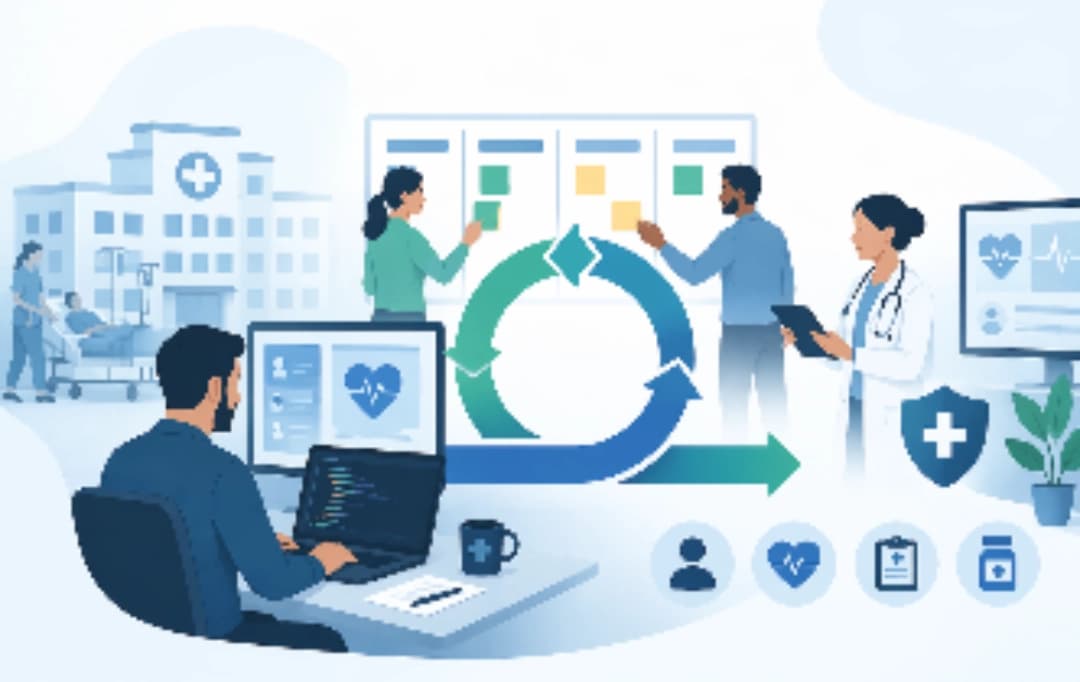
 The architectural integrity of a healthcare platform is the difference between a scalable, life-saving tool and a multi-million-dollar liability. Choose the right development strategy to ignore the nuances of clinical workflows and regulatory shifts.
For a healthcare software development project, the chances of choosing between Agile vs. Waterfall in healthcare are fundamentally different from any other industry. A misconfigured ERP system creates financial friction. A misconfigured clinical decision support tool creates patient risk. That is the gap. And it is the reason why SDLC in healthcare software is not a back-office operational question. It is a product strategy question, a compliance question, and in some contexts, a patient safety question.
But why does the methodology choice actually matter? The choice between Agile and Waterfall shows how a project handles the different phases of the Software Development Life Cycle (SDLC). For example, a hospital upgrading its legacy systems needs a different approach than a startup launching a patient monitoring app.
This editorial gives healthcare startup founders, hospital administrators, HealthTech entrepreneurs, and developers a direct, research-backed answer to the Agile vs. Waterfall in healthcare software development debate. No filler. No blanket endorsements. Just the framework you need to make the right call for your specific project.
Agile vs. Waterfall: Key Differences in the Healthcare Context
When we look at Agile vs. Waterfall in healthcare software development, we are looking at two fundamentally different philosophies. One prioritizes structure and predictability, while the other thrives on flexibility and rapid iteration. Both have their place, but knowing where each excels is crucial for project success.
Below is a detailed comparison to help you visualize the core differences:
| Dimension | Agile | Waterfall |
|---|---|---|
| Project structure | Iterative sprints (1–4 weeks) | Linear, sequential phases |
| Requirements flexibility | Evolving; adjusted per sprint | Fixed at project start |
| Regulatory documentation | Continuous, embedded in sprints | Comprehensive upfront, phase-gate reviewed |
| Compliance posture | Requires deliberate compliance-by-design | Naturally aligns with audit trail demands |
| Testing approach | Continuous testing throughout | Testing phase occurs post-development |
| Time-to-market | Faster through incremental delivery | Longer, full product delivered at completion |
| Stakeholder involvement | High throughout; regular sprint reviews | Front-loaded at requirements; limited mid-project |
| Risk profile | Distributed across sprints; earlier defect detection | Concentrated; late-stage failures are expensive |
| Budget predictability | Variable scope can evolve | High, defined upfront |
| Best for | MVPs, patient-facing apps, SaMD with evolving specs | HMS, EHR upgrades, government contracts |
| Team structure required | Cross-functional, self-organizing | Siloed specialists with defined handoffs |
| Change management cost | Low to moderate per sprint | High; change orders are expensive post-requirements |
| IEC 62304 alignment | Achievable with Compliant Agile frameworks | Natural alignment with waterfall lifecycle requirements |
What is the Waterfall Model in Healthcare Software Development?
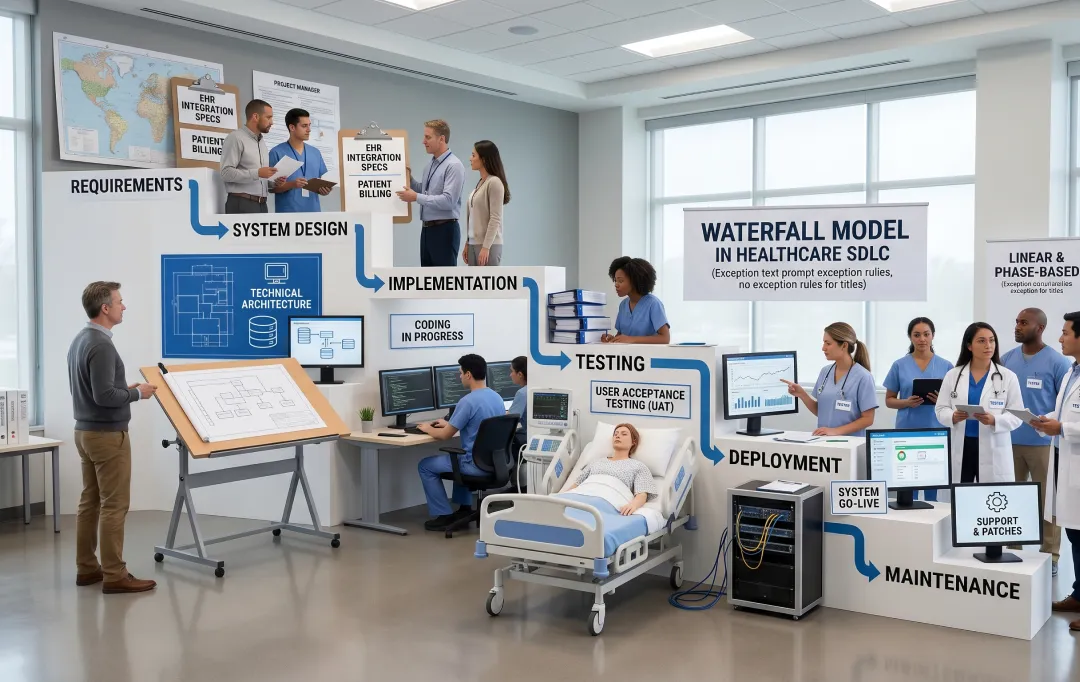
The Waterfall model is the traditional approach to software engineering. It is a top-down strategy where you do not move an inch forward until the previous step is completely buttoned up. In the healthcare sector, this translates to a rigid sequence: you plan every detail, you design the whole architecture, and only then do you actually start the build. It is the architectural equivalent of pouring a concrete foundation for a hospital.
When choosing between the Agile vs. Waterfall methodologies in healthcare, the waterfall methodology has served as the baseline for decades in highly regulated sectors. Its predictable nature is a comfort to stakeholders who need to see a clear map of project timelines and specific milestones. In a field where documentation is not just a preference but a legal necessity, Waterfall provides a clear paper trail from the initial requirement gathering to the final deployment.
How Waterfall Works in a Healthcare Project?
Let us look at a complex project, such as a hospital management system. Under a Waterfall setup, your team will spend months in the trenches with clinicians, nurses, and IT directors just to nail down every single functional requirement. You eventually produce a massive stack of documentation that requires a formal sign-off before a single line of code is ever written.
This sequential flow guarantees that every stakeholder is on the same page from the start. However, the trade-off is significant. You will not see a functional, working version of the software until very late in the development cycle. If the testing phase uncovers a deep logic error or a workflow mismatch that the clinicians missed in the planning stage, the cost to backtrack and fix it is astronomical.
Also Read: Understand The Software Development Languages
What is the Agile Model in Healthcare Software Development?
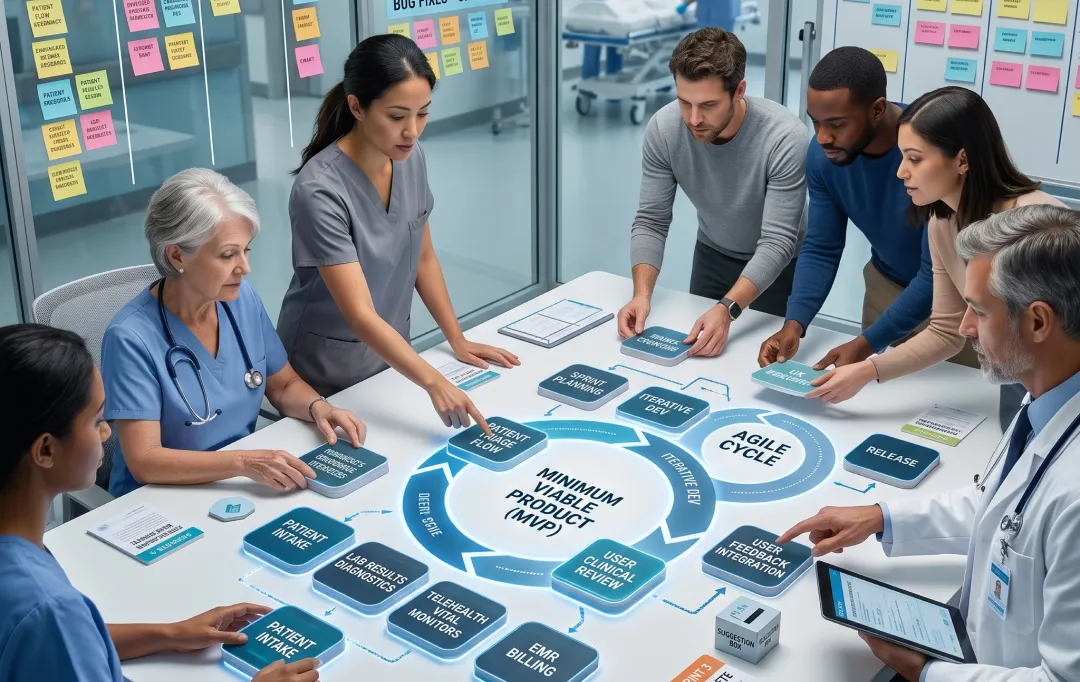
Agile is a mindset focused on delivering value in small, manageable chunks. Rather than banking everything on a single massive launch date, you break the Software Development Life Cycle (SDLC) into two to four-week mini-releases known as sprints. At the end of every single sprint, you have a tangible, working piece of software that can be audited, tested, and vetted by actual clinicians.
This methodology is perfect for the modern HealthTech landscape. It acknowledges that we don't always have all the answers at the start of a project. By adopting a build, measure, and learn loop, your development team gains the tactical flexibility to pivot when user feedback or a sudden regulatory shift changes the landscape. This is why the Agile vs. Waterfall in healthtech software debate often leans toward Agile for patient-facing applications where user experience is the primary driver of adoption.
How Agile Works in a HealthTech Project?
Imagine your team is developing a patient-facing telemedicine app. In a traditional setup, you might wait a full year for a release. Under an Agile software development in healthcare framework, you could push a core video consultation feature to a pilot group within three months. As doctors and patients begin using that specific module, your developers are already neck deep in the next sprint, perhaps focusing on digital prescription integration.
This iterative loop allows your project to benefit from real-world data almost immediately. If a pilot group of nurses finds the triage workflow confusing, the development team can rectify that in the very next sprint. You are not stuck waiting for a post-launch update six months down the line. It fosters a culture of constant refinement, ensuring that the final product does not just meet the original spec sheet but actually solves the problems of your clinical staff.
Agile vs. Waterfall for Medical Software Development: Use Case Scenarios
The decision between Agile vs. Waterfall for medical software development is usually dictated by the level of risk and the clarity of the end goal. If you are building something with zero room for error, you need structure. If you are building something that depends on user behavior, you need speed.
When Waterfall is the Smarter Play for Healthcare Software
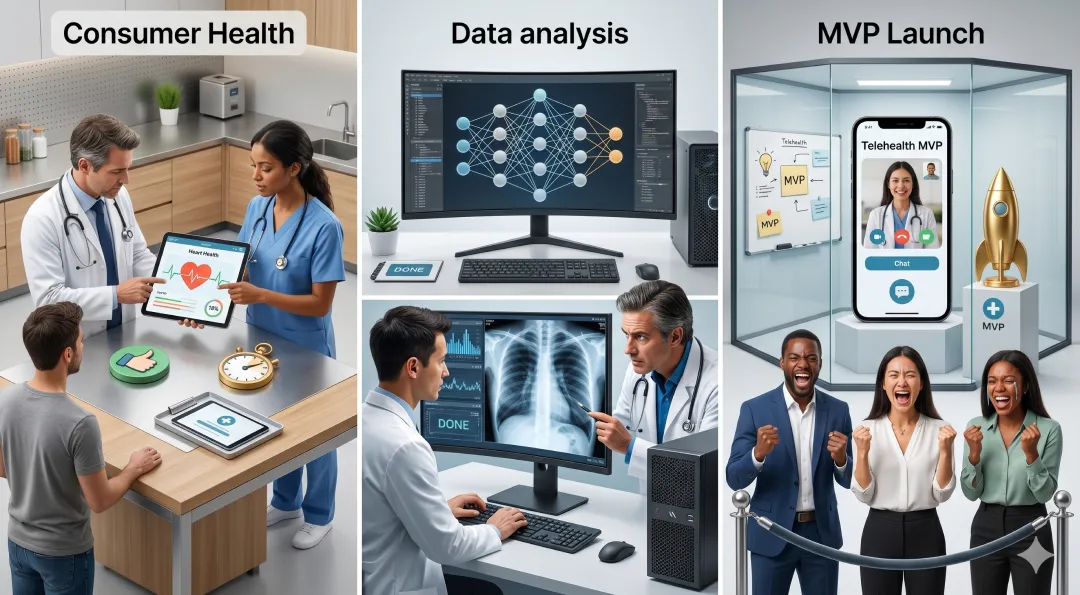
Waterfall remains a dominant force in the Software Development Life Cycle (SDLC) for projects where the cost of a mid-stream change is too high. It provides a level of architectural certainty that institutional stakeholders often demand before releasing capital.
1. Enterprise-Level Hospital Management Systems
Hospital Management Systems are massive, multi-departmental ecosystems where the requirements are usually set in stone from the first day of planning. These systems require deep integration with existing hardware and legacy databases. The phase gate validation process of the waterfall aligns perfectly with how hospital IT governance teams operate. It ensures every department, from pharmacy to surgery, has its needs documented before a single line of code is written.
2. Revenue Cycle and Medical Billing Platforms
When building platforms for medical billing, you are dealing with a fixed regulatory scope dictated by CMS billing codes and insurance API specifications. Because the logic is based on established laws and protocols, there is very little room or need for iterative experimentation. Choosing Waterfall here allows leadership to maintain a strict grip on the software development cost while meeting every compliance milestone on time.
3. Class C Medical Device Software and Regulatory Compliance
For high-risk medical device software, specifically those falling under IEC 62304 Class C, safety is the only metric that matters. Regulators demand absolute traceability from the initial requirement to the final testing phase. Waterfall provides a clear and unchangeable paper trail that is essentially built into the process. This makes the final audit for FDA or CE approval much more straightforward compared to the fluid nature of other models.
When Agile Takes the Lead for HealthTech Software
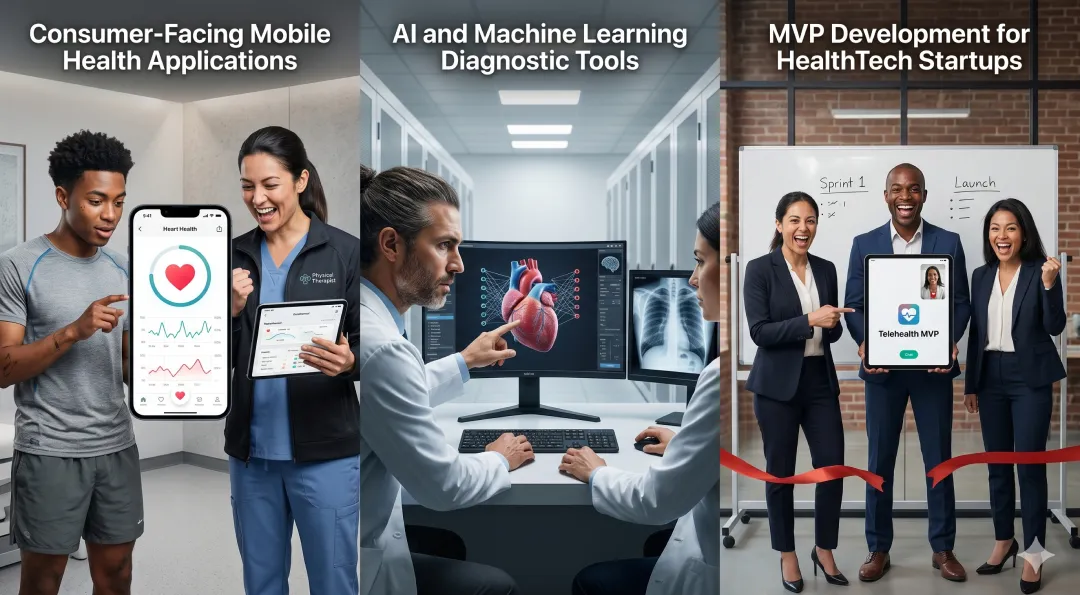
Agile is the go-to for software that relies on user engagement and rapid adaptation. While exploring the different types of healthcare software, Agile allows for continuous UX refinement based on real-world data rather than just guessing during a long planning phase.
1. Consumer-Facing Mobile Health Applications
For any product where the patient is the end user, the priority shifts toward high engagement and iterative feedback. Patient needs evolve quickly, and what worked in a prototype might not work in the real world. Agile allows your team to push a feature, see how users interact with it, and refine the interface in the very next sprint. This keeps the product relevant and user-centric.
2. AI and Machine Learning Diagnostic Tools
AI-driven tools are inherently experimental. Machine learning models require constant training, validation, and refinement cycles that do not fit into a linear timeline. The sprint structure of Agile is a perfect match for the way AI in healthcare products are actually developed. It allows data scientists and developers to iterate on the diagnostic logic based on fresh datasets without breaking the entire project plan.
3. MVP Development for HealthTech Startups
If you are a startup founder, your biggest enemy is time. You need to get a minimum viable product into the hands of clinicians to validate your concept and secure your next round of funding. Waterfall would keep you in the planning phase for months. Agile gets you to a functional pilot faster, allowing you to iterate toward product market fit based on real clinical demand. Before you pick a partner for this journey, list down some questions to ask before hiring a software vendor to ensure they can handle the pace.
The Hybrid Approach: Agile-Waterfall in HealthTech Software
The hybrid setup functions by using the Waterfall model for the foundational phases of the SDLC. Developers take care of the big picture stuff, like the initial requirement gathering and your regulatory strategy, up front. But once that architectural foundation is locked down, the team switches gears. The actual coding and feature building happen in Agile sprints. This gives you a rigid compliance shell with a flexible, iterative core.
This specific balance is incredibly helpful when you are experiencing major software development challenges like connecting to a mess of legacy hospital systems or migrating sensitive patient data through third-party APIs. It keeps the project on track without stifling the engineers who need to solve technical roadblocks on the fly.
Also Read: A Quick Guide on Healthcare Software Development
Bridging the Gap Between Compliance and Innovation
The real logic behind the Hybrid model is how it splits the workload across different project stages to satisfy both auditors and end users. During the initial design and planning phase, the focus remains on heavy documentation to stay on the right side of ISO 13485 or HIPAA. Once that safety net is established, the development team shifts into a cycle of sprints. They can build a specific tool, put it in front of a focus group of clinicians, and then refine the interface based on how those doctors actually interact with the screen.
This ensures you do not waste months building a technically compliant platform that is a nightmare for a nurse to use in a live clinical setting. It creates a steady feedback loop within a safe, structured environment. For any founder trying to identify the best SDLC model for healthcare, the hybrid path is often the only way to reach a successful market launch without compromising on safety or the actual user experience.
Cost Structure: Agile vs. Waterfall for Healthcare Projects
Cost is one of the most practical factors in methodology selection. Here is a direct breakdown of how each model structures investment, where costs concentrate, and what the total cost of ownership looks like across a typical project lifecycle.
| Cost Category | Agile (USD) | Waterfall (USD) |
|---|---|---|
| Initial planning and requirements | $10,000 – $30,000 | $30,000 – $80,000 |
| Development (basic platform) | $30,000 – $80,000 | $40,000 – $100,000 |
| Development (mid-complexity) | $80,000 – $200,000 | $100,000 – $250,000 |
| Development (enterprise platform) | $200,000 – $400,000 | $250,000 – $500,000+ |
| HIPAA compliance integration | $15,000 – $40,000 | $10,000 – $25,000 |
| IEC 62304 / FDA validation | $20,000 – $60,000 | $15,000 – $50,000 |
| QA and testing | $10,000 – $30,000 per sprint cycle | $30,000 – $80,000 (single phase) |
| Mid-project change requests | $5,000 – $20,000 per sprint | $20,000 – $100,000 per change order |
| Post-launch maintenance (annual) | $20,000 – $60,000 | $30,000 – $80,000 |
| Total (basic to mid-complexity) | $80,000 – $250,000 | $100,000 – $350,000 |
| Total (enterprise) | $300,000 – $600,000 | $350,000 – $750,000+ |
How to Choose the Right SDLC Methodology for Your Healthcare Software Project?
The Agile vs. Waterfall in healthcare model decision is not one-size-fits-all. Here is the decision framework to help you find which methodology is best for your next project:
| Project Type | Recommended Methodology | Key Reason |
|---|---|---|
| Patient mobile health app (MVP) | Agile | Evolving UX requirements; speed to market critical |
| Telemedicine platform | Agile or Hybrid | Feature complexity + regulatory compliance (HIPAA) |
| AI diagnostic tool (SaMD) | Hybrid | Iterative model training + IEC 62304 compliance |
| Hospital Management System | Waterfall | Stable scope; enterprise procurement; audit requirements |
| EHR platform upgrade | Waterfall or Hybrid | Fixed integration scope; high compliance documentation needed |
| Clinical decision support tool | Agile | Evolving clinical evidence-based, continuous iteration |
| Medical billing platform | Waterfall | Regulatory scope fixed; budget predictability critical |
| Remote patient monitoring platform | Agile or Hybrid | Evolving device integrations; regulatory complexity |
| Government health infrastructure | Waterfall | Fixed-price procurement; formal milestone deliverables |
| Healthcare data analytics platform | Hybrid | Non-clinical UI in Agile; PHI pipeline in Waterfall-style |
| Pharmacy management system | Waterfall | Stable regulatory scope; formulary compliance requirements |
| HealthTech startup, pre-revenue | Agile | MVP validation; capital efficiency; speed to clinical feedback |
Also Read: Evaluate The Software Development Checklist
Conclusion: Which Methodology Wins for Healthcare Software Development?
The winner of the Agile vs. Waterfall debate is not limited to selecting just one methodology. The right methodology is the one that fits the regulatory classification of your software, the stability of your requirements, the structure of your team, follows the latest software development trends, and takes into account the financial constraints of your project.
Waterfall remains the right choice for enterprise-scale, fixed-scope healthcare systems where documentation integrity and budget predictability are primary requirements. For patient-centric software and AI tools, Agile is the king of innovation.
As we look toward the future, the ability to be adaptable while remaining compliant is the hallmark of a successful healthcare firm. Experts can help you audit your requirements and pick the best SDLC model for healthcare projects. MobileAppDaily is a leading resource that can connect you with top-tier healthcare software development companies. They provide the insights and directory access you need to understand the Agile vs. Waterfall comparison in a real-world context, ensuring your project starts on the right foot.
Frequently Asked Questions
What is the best SDLC methodology for healthcare software development?
There isn't a one-size-fits-all answer here. It depends entirely on your project’s risk level. If you are building a high-stakes medical device, Waterfall’s structure is often a lifesaver for compliance. For patient-facing apps that need constant updates, Agile software development in healthcare is usually the better bet.
Can Agile be used for FDA-compliant healthcare software?
Yes, but you have to weave your compliance checks and documentation into every single sprint. Most successful teams in 2026 use a hybrid approach to satisfy FDA auditors while keeping their dev speed up.
Is Waterfall better than Agile for HIPAA-compliant systems?
Not necessarily. While Waterfall gives you a clean paper trail at the end, Agile allows you to run security tests every few weeks. In an era of constant cyber threats, catching a vulnerability in a sprint is much better than finding it during a big test right before launch.
What is the cost difference between Agile and Waterfall for healthcare projects?
Waterfall looks predictable with a fixed price, but scope creep often makes those costs explode later. Agile works on a recurring burn rate that focuses on high-value features first. Over time, Agile often offers a better ROI because you aren't paying for features that clinicians won't actually use.
Which methodology is better for a healthcare startup — Agile or Waterfall?
Agile, without a doubt. Startups need to prove their concept to investors as fast as possible. You need the ability to ship an MVP, gather clinical feedback, and pivot. A Waterfall approach is often too slow and rigid for a young company trying to find its footing in a crowded market.
Can a project switch from Waterfall to Agile midway?
It’s a massive headache, but it can be done. You’ll have to pause the project, tear down your old roadmap, and essentially retrain your stakeholders to work in sprints. It’s a culture shock that requires 100% buy-in from the leadership team to succeed.
How do I know if my team is ready for Agile?
Ask yourself two questions: Can your clinicians spare time for weekly reviews? Is your leadership comfortable with shifting priorities? If your board demands a fixed date, fixed price guarantee for every minor feature, you’re probably better off sticking with a more traditional model for now.

Uncover executable insights, extensive research, and expert opinions in one place.
Related Content